

Click here for a brochure handout copy of EMDR ?
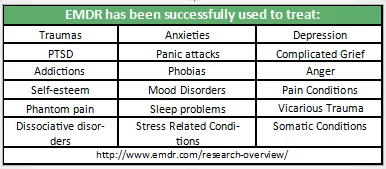
Eye Movement Desensitization and Reprocessing (EMDR) was developed by Francine Shapiro in 1987. She noticed that while she was contemplating and concentrating on one of her issues during a walk through a park, that her eyes were moving back and forth, much in the same way as rapid eye movement (REM) occurs during sleep to digest daily experiences. She wondered if a similar process, consciously directing the rapid eye movements (REM) could treat Post-traumatic Stress Disorder (PTSD). She devised a protocol, administered it to her clientele, many of whom were war veterans suffering from PTSD, and researched the effects of this treatment. From the beginning this treatment proved helpful and continues to prove to be successful in reducing the symptoms of traumatic stress for long periods of time, thus restoring mental health to sufferers. Since then, EMDR has been used to effectively treat a wide range of traumatic stress responses and mental health problems.
Is EMDR is an effective treatment?
EMDR is an innovative clinical treatment which has successfully helped over a million individuals. The validity and reliability of EMDR has been established by rigorous research. There are now nineteen controlled studies into EMDR making it the most thoroughly researched method used in the treatment of trauma. (Details can be found at www.emdr.org and www.emdr-europe.org) EMDR is recommended by the National Institute for Health and Clinical Excellence (NICE) as an effective treatment for PTSD.
Traumatic Stress Response - What’s Happening?
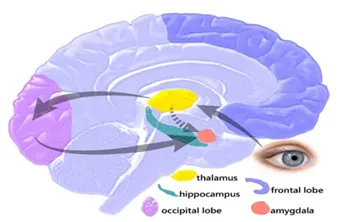
Normally, the body manages new information from your regular experiences without you being aware of it. However, a sudden overwhelming event such as a car accident, or when one is repeatedly subjected to childhood neglect or emotional abuse in a significant relationship, are not ordinary. These traumas overload your natural physical, mental and emotional systems’ abilities for generating, organizing, processing and healing. These systems become unable to digest and eliminate the toxic elements of those past experiences. Remember with traumatic stress, the overloading of your biosystems are caused by these unresolved disturbing experiences, which further establish disordered and dysfunctional qualities in your health. Simply because they are unprocessed, they remain stuck in your bodily tissues and brain. The energies of traumatic memories of a specific event are maintained in your brain’s limbic system within an isolated memory network that is associated with emotions and physical sensations, and which are disconnected from the brain’s cortex where language store memories. The limbic system’s isolated and charged traumatic memories can continually trigger your brain's amygdala, causing present similar events to be wrongly perceived as a threat. This confusion between a past traumatic event with a similar but non-threatening incident in your present life, creates inappropriate responses and behaviors that may be embarrassing and problematic. (A common example is a war veteran being activated by a car exhaust backfire.) Often the initial memory itself is long forgotten (suppressed), but the suffering and painful feelings (symptoms) persist, such as anxiety, panic, anger, judgement, jealousy, or despair. In this way, your ability to live in the present and learn from new experiences can become obstructed.
These immobilized memories impact your consciousness, your levels of clarity and coherency, and the quality of your life. These suppressed and unprocessed memories exist continually at a conscious and unconscious level. They are living images of sensing, feeling, thinking, emoting, reasoning, wanting, intending, recognizing, and identifying, and are stored in your biosystems in a "raw" form. These images need processing, understanding and healing. EMDR helps create the connections between you and your brain’s memory networks, enabling your brain to process the traumatic memory in a very natural way.
What happens before an EMDR session?
Collaboratively, the practitioner and the client work to build a safe, stable and resourced platform. Then the client's personal history is reviewed and an initial assessment is made as to the suitability of EMDR. If suitable, a memory or event is selected to be processed.
What’s happening in an EMDR session?
As an overview, you will be attending to what you are experiencing inside you - your body and mind - while simultaneously attending to what’s happening outside of you.
The natural healing ability of your body is accessed through dual attention and bilateral stimulation. Dual attention is consciously holding a memory and its images and experiences of an event, while focusing on the bilateral stimulation being directed by the practitioner towards your body.
Bi-lateral stimulation occurs when the right and left hemispheres of the brain are stimulated by sensory signals. EMDR variously uses visual, auditory. and tactile signals depending on the suitability for and preference of each client. This may be accomplished by watching the Practitioner’s fingers move left to right across your visual field at a comfortable distance from your eyes; or perhaps it will be more comfortable for you to listen to a sound as it moves from your left ear to your right ear; perhaps feeling a vibration or a touch alternate from your right hand to your left hand might suit you better. These signals may be generated by the Practitioner or the EMDR kit provides equipment which generates bi-lateral visual, auditory and tactile signals.
Whichever style you choose, each cycle will last for a short time and then stop. You will then be asked to report on what you experienced. Experiences during a session may include changes in images, thoughts, emotions, sensations, and feelings. Sensing these bilateral signals while attending to your inner images and experiences support the metabolic discharge of distressing traumatic memory. This metabolic process restores fluidity, vitality, and resiliency within your body and your mind.
With repeated sets of bi-lateral stimulation, the memory tends to change in such a way that it loses its painful intensity and simply becomes a neutral memory of a past event. Also, other associated memories may heal at the same time. This linking of related memories can lead to a dramatic and rapid improvement in many aspects of your life. By resolving the impact of your past traumas, you may allow yourself to live more fully in the present and have the quality of life you choose.
Is EMDR is for me?
Even though EMDR may accelerate therapy, it is not for everyone. Note: you need to be aware of and willing to experience the strong feelings and disturbing thoughts which sometimes may occur during or between sessions. Usually any disturbing experiences, if they occur at all, last for a comparatively short period of time. Together, we can discuss the appropriateness of EMDR for you.
How long does treatment take?
EMDR can be brief, focused treatment or part of a longer self- improvement program. EMDR sessions can be for 60 to 90 minutes. Weekly treatments are recommended.
You remain in control and empowered!
During EMDR treatment, you will remain in control, fully alert and wide-awake. This is not a form of hypnosis and you can stop the process at any time. Throughout the session as little interference as possible is given to support and instill your own self-healing processes. Reprocessing of your memory is usually experienced as something that happens spontaneously, as new felt connections and insights arise quite naturally from within. As a result, most people experience EMDR as being a natural and very empowering therapy.
Contact me for assistance in establishing a portal of self healing.